Japan was not late. The shelf was
Korean trends are supposed to reach Japan after a delay. Tested against the data, the gap in finding out was next to nothing; what lagged was the date the product reached the shelf. By the time it did, Korean search volume was at 1.4% of its peak.
“Things that take off in Korea reach Japan some time later.” It is written as a premise in almost any article about Korean consumer trends. Two years of search data and the release records of the Japanese convenience-store chains were used to test whether it holds.
Half of it did not survive. The gap in finding out was one month, which is effectively simultaneous. What was out of step was the date the product went on sale, four to six months later. And by that point, Korean search volume was at 1.4% of its peak.
The subject is a chain of products, not one product
What was measured is the group of products around 두쫀쿠 (dujjonku), short for 두바이 쫀득 쿠키 (Dubai chewy cookie); the abbreviation settled on Korean social media. A marshmallow-like chewy dough is wrapped around kadayif — very fine shredded pastry — with pistachio cream and chocolate. What it is known for is a texture that changes in two stages, chewy then crunchy.
The starting point is the 2024 Dubai chocolate bar, a slab filled with kadayif and pistachio. In Korea a variant appeared with the shell swapped for a rice-cake-style dough. Measuring “the Dubai chocolate trend” through one single product therefore misreads it. It has to be read as a chain that keeps the ingredients and changes the form.
Inside Korea the chain kept going: 아쫀쿠 with almond, 이쫀쿠 in an Italian style. It spread from large chains such as Paris Baguette and Tous Les Jours to independent cafés in Seongsu and Hongdae, and onto the menus of gukbap restaurants and sushi shops. Prices run 5,000–10,000 won a piece, a scale large enough to move the import volume and price of kadayif and pistachio.
On the Korean side, the peak is January 2026
Five desserts were taken in one single request and put on the same scale. Monthly average search volume.
Six months up, four months back down. In September 2026 it reads 0.7, which is 1.1% of the peak. The word is still in use; it is no longer something people look up.
The size of it becomes clear once the other desserts are put on the same scale.
두쫀쿠 stands well clear of the rest — 19 times 왁뿌볼, which was introduced to Japanese-language readers this June. 탕후루 has run at around 0.7 across the whole two years and is finished as a trend. It is often listed alongside the others as “a dessert that is popular in Korea”, and the difference in scale is large.
소금빵 (salt bread) is the one that makes no peak at all, holding around 1.0. That is not a trend. It is the shape of a product that has settled.
Finding out about it took one extra month
Next, when it became known in Japan. Videos posted were counted by month, and the position of the peak compared between Korean and Japanese. The counts themselves are approximate, so only the position of the peak can be read — which is enough for this question.
One month apart, which is effectively simultaneous. For information moving on social platforms, the border is no longer much of an obstacle. As far as awareness goes, “it arrives after a delay” did not hold.
The shelf, though, took four to six months
The dates products in this line reached Japanese convenience stores, gathered from company announcements and press coverage.
- February 24, 2026 — Lotte Dubai-style chocolate bar, FamilyMart exclusive, 288 yen. An ice bar, not a chocolate slab
- April 10, 2026 — Natural Lawson “Dubai-style chewy cookie, chocolate”, 702 yen. Marshmallow dough around kadayif and pistachio: the same form as 두쫀쿠
- April 21, 2026 — 7-Eleven “Dubai choco mochi”
- June 9, 2026 — 7-Eleven “Dubai jjondeuk cookie, chocolate flavour”, 537 yen. A product of the Korean brand KOKO; the name is a transliteration of 두쫀쿠
- July 21, 2026 — the three major chains put out “Dubai-choco-style sandwiches” within days of each other
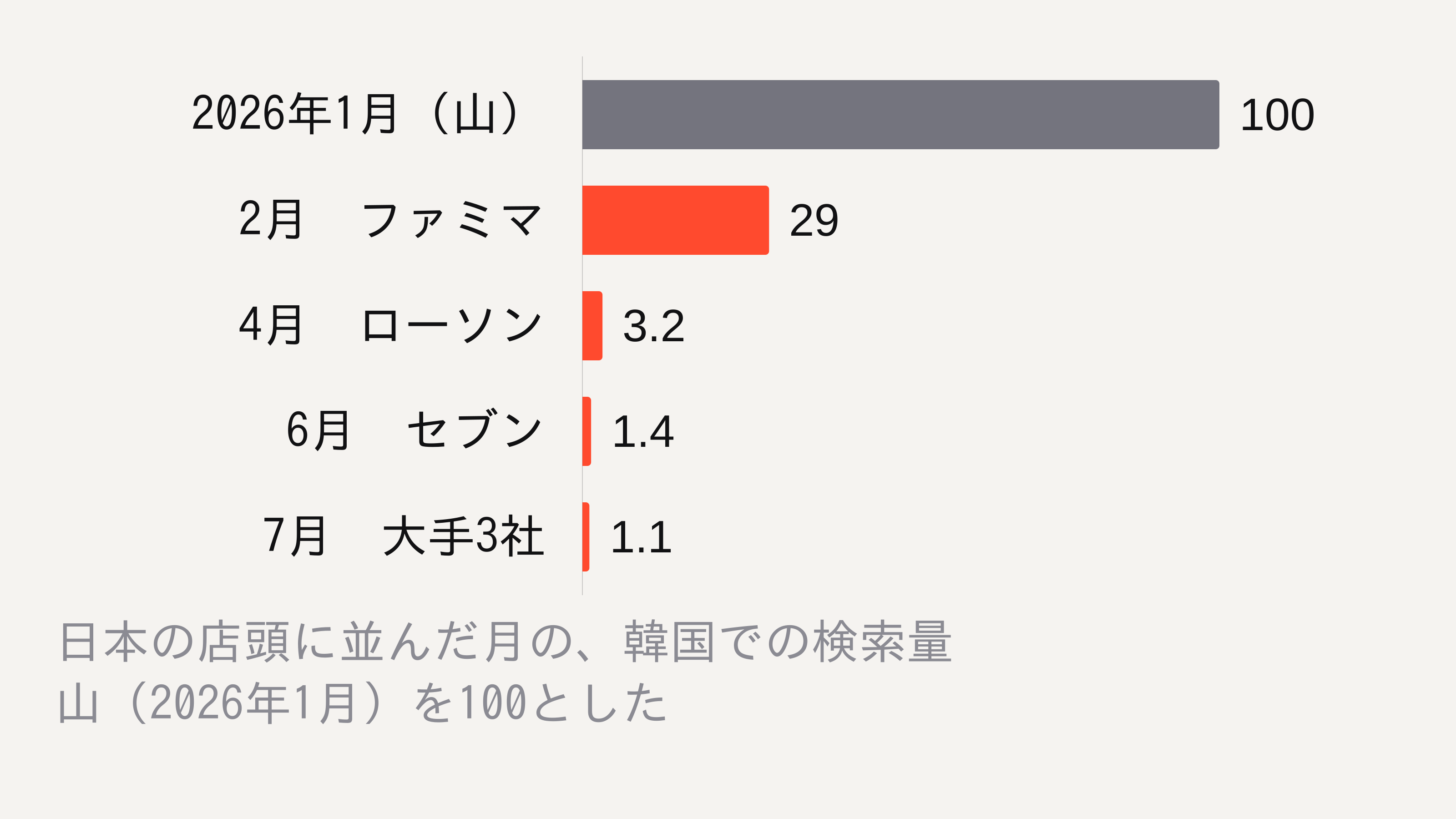
The Korean peak is January 2026. On February 24, when the first product landed, Korean search volume was already down to 29% of the peak. By April it was 3%, and by June 1.4%.
The June 9 item states the structure plainly. “Dubai jjondeuk cookie” is the Korean 두쫀쿠 written straight into katakana, sold in a Japanese convenience store as a Korean company's product. Korean search volume that day was 1.4% of the peak.
Knowing and stocking run on different clocks
The time a video needs to cross a border and the time a product needs to reach a shelf are not the same order of magnitude. Securing ingredients, booking production slots, making packaging, negotiating, shipping. With materials like kadayif and pistachio, which Japanese confectionery handles rarely, procurement alone adds more time.
On top of that, a convenience-store product is decided once the thing has been confirmed to be widely known. The machine moves after the talk has settled, not while it is happening. Awareness can be simultaneous and distribution will still be structurally late.
The problem is that in those four to six months the Korean side has moved on. In April 2026, when the Japanese shelf caught up with Dubai chocolate, 왁뿌볼 was already rising in Korea (0.3 in February, 3.4 in June). By June, when the shelf reached 두쫀쿠 itself, 왁뿌볼 was at its own peak.
The same method did not work for tanghulu
탕후루 was tried as a comparison, and inside these two years neither side produced a peak. The Korean trend was in 2023, before the observation window opens.
A first pass returned “Japan is five months behind”. But the Japanese peak sat at the edge of the window, with none of the climb inside it — a peak outside the period being stood in for by the edge of the period. The arithmetic was right and the answer was not an answer, so the pair was dropped.
This method can measure a lag only where both the rise and the fall sit inside the observation window. The Dubai chocolate line is one of the few cases that met the condition.
What the test concludes
“Japan is behind Korea” is inaccurate because it does not say behind in what. From this data it sorts out as follows.
- Awareness is near-simultaneous. On social platforms there is almost no gap
- Being able to buy it comes four to six months after the peak. Procurement, manufacturing and negotiation take exactly that long
- During those four to six months, the next product is already rising locally
- So what lands on a Japanese convenience-store shelf is closer to “what was popular in Korea” than to “what is popular in Korea”
This is not a judgement that Japanese planning is slow. Putting something on a shelf requires certainty, and certainty is only bought with time. It is a statement about structure.
The practical reading is simple. A convenience-store shelf should be read as Korea four to six months ago, not as Korea now. To know what is coming next, you have to look at the numbers rising locally rather than at the shelf.
And 왁뿌볼, the one that was rising, peaked in June and has been coming down since (3.4 to 1.2). Whatever comes next has not settled on a name yet.
From the desk. When a Korean sweet turns up in a Japanese convenience store, treat it as the answer sheet rather than the preview. By the time it is on the shelf, search in Korea is down to the 1% range of the peak. Finding out is not the slow part. Being able to buy it is.
Put the other way round, what is on the shelf is also the form that survived in Korea. The 두쫀쿠 line was rebuilt over and over for half a year, and what came through was that two-stage texture, chewy then crunchy. Arriving after the trend ends means fewer misses.
If you genuinely want to be ahead of it, the shelf is the wrong place to look. The only place is the moment an abbreviation nobody has translated yet starts moving on Korean social platforms. That is why the dessert words are collected here every day.
Sources
Read next
Related
The chocolate you crack open has already passed its peak in Korea
A thick chocolate shell you break apart with your hands. In Korea it is called 왁뿌 (wakppu). Checked against Korean search volume, the peak was three months ago. By the time the trend is written up abroad, the country has moved on.

A Korean convenience-store hit takes six months to build and four to erase
Two Korean dessert trends followed end to end, from first sign to gone. Both took six months from lift-off to peak, and four months from the peak back to where they started. Almost the same speed. The stage for both was the convenience store.
A bread you cannot buy in Korea. What is being sold is not the taste
Searches for the collaboration bread CU released on September 17 were still pointing up on the Korean side through September 25. On the two days when three of the four other words in the same request fell, this one rose 51.5%. The product name gets searched; the photocard gets written about.