The chocolate you crack open has already passed its peak in Korea
A thick chocolate shell you break apart with your hands. In Korea it is called 왁뿌 (wakppu). Checked against Korean search volume, the peak was three months ago. By the time the trend is written up abroad, the country has moved on.
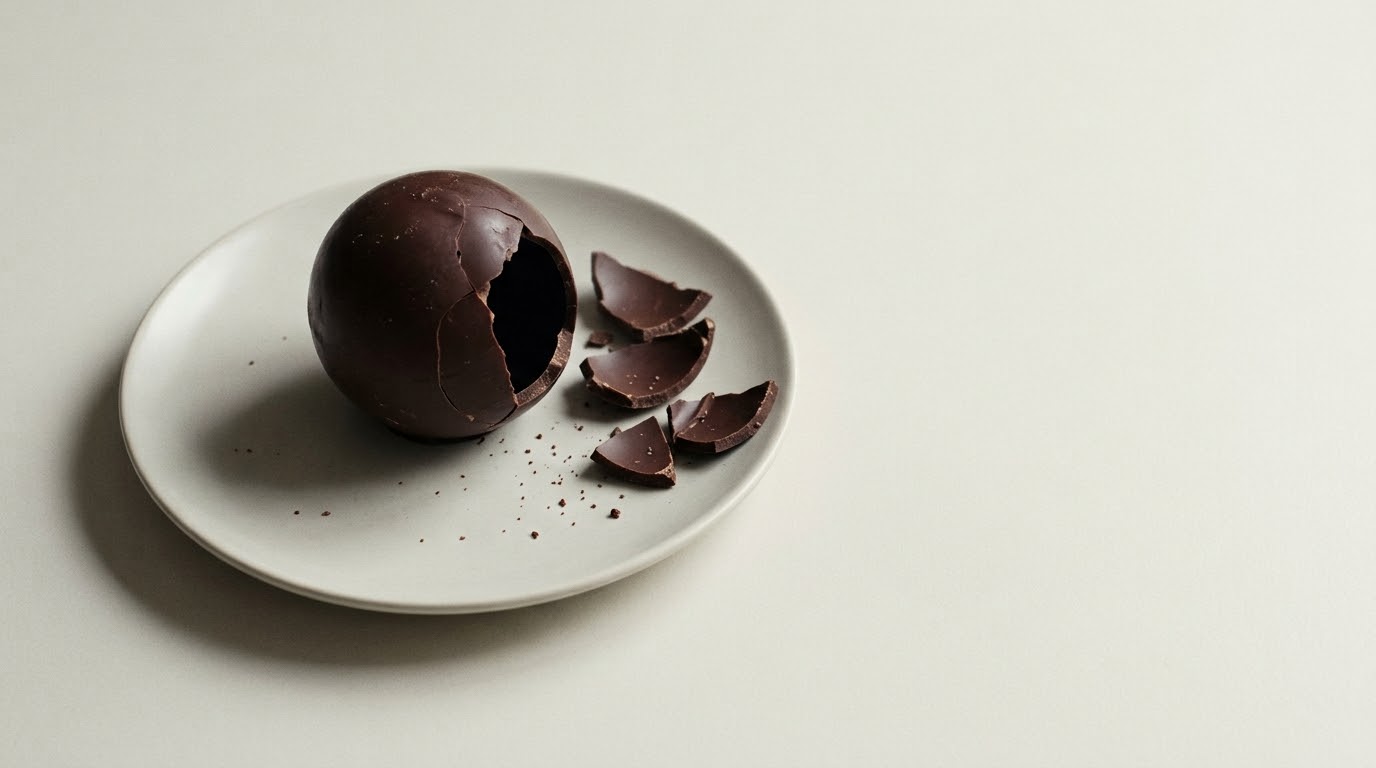
A dessert you smash with your hands is trending in Korea. Thick chocolate splits open, cream runs out, the crack and the crunch are the point, and social media did the rest. That is how it is written up outside Korea. Measured against how much Koreans are actually searching for it, the story reads the other way round.
First, the thing has a name, and the name is 왁뿌
Before anything else, the word. In Korea this is called 왁뿌 (wakppu), a contraction of something close to 와그작 뿌셔 — smash it up loudly. The word did not exist until last autumn. Foreign write-ups tend to describe it as “the dessert you break,” which is a translation of the meaning, not the name anyone uses on the ground.
Only 왁뿌 stands out. A year ago it sat below the level at which a figure comes back at all, so it is a genuinely new word. The interesting part is that 아그작 and 와그작, the two words usually quoted alongside it, have barely moved. Both are ordinary onomatopoeia that existed already, and neither rose with this trend.
One caution on that table. These are relative values from a single request, so they say which word is typed more often — not how many people typed it, and not how many packs were sold.
So one word carries this trend, and everything else in the list is vocabulary that the people summarising it added for the sake of explanation.
That is also how this kind of Korean slang is built. Take a sound word and the verb next to it, keep the front of each, and you have a name short enough to type. 와그작 뿌셔 becomes 왁뿌. A phrase that describes the act in full sentences, like 뿌셔먹는, never gets shortened, because nobody needed a name for it in the first place.
The peak was three months ago
The item at the centre of it is 왁뿌볼, a chocolate shell you freeze and then break. Lay out a year of monthly search volume and the shape is unambiguous.
Nothing last autumn, a climb through spring, a peak in June, and a fall since. It now stands at a third of the peak. Over the most recent week it is down 14.8% against the week before, so it has not flattened out either.
What that fall does not say is that the product is gone. Search measures how often a name is typed, and a name stops being typed once people know what the thing is. The curve says interest in finding out has drained away; it does not say the last box has left the warehouse.
It also does not say the trend was small. At the peak this word was carrying the whole category on its own, which is exactly why the shape is so clean. Things that never had a single name do not produce a curve like this.
The items listed alongside it were never a trend to begin with
Round-ups put several other products next to 왁뿌볼 as part of the same wave. Their search volumes tell a different story.
These four came from one request, so the ranking holds even though the absolute heights mean nothing on their own. 크로칸슈 at 0.7 is simply not being looked for. It was placed in the list, nothing more. 소금빵, introduced in the same breath, has gone from 18.3 a year ago to 8.7, close to half. That is not a trend arriving; that is the shape of something past its peak and settling in.
The videos say the same thing
Search alone is a thin basis, so we looked at video as well. Collecting recent Korean-language dessert uploads on YouTube and sorting by views, no video with 왁뿌 in the title reaches the top any more. What is there instead is a Daiso new-product review, over 330,000 views.
The order matters. Video moves before search does. Someone eats the thing and posts it; people who watch then type the name. So a word dropping out of the top videos is a reasonable signal that search will keep falling behind it.
The videos are gathered per entry word rather than scraped whole, so this is a sample of what a given phrase returns, not a census of Korean YouTube. Used that way it answers one narrow question well: is anyone still making this, and is anyone still watching it.
Why a round-up is always standing at the back of the queue
Follow the sequence. A product ships, social media picks it up, stores run out, the shortage becomes news, and only then does it get filed under “what is trending now.” By the time the round-up exists, it is already several steps behind.
Then add the time it takes to be translated and re-published in another language. By the time you read that this is trending in Korea, Korea is onto the next thing. This time, that gap came out cleanly in the numbers.
There is a structural reason the list grows longer as it travels, too. A round-up needs more than one example, so items that were never searched get pulled in to fill the shape of a trend. 크로칸슈 at 0.7 is in the list for the same reason 아그작 is: someone needed a second item, and it looked close enough.
How to read a Korean trend from outside Korea
- Is the name itself being searched in Korea? If only the descriptive phrase travels, the trend may have been assembled by the people describing it
- When did it start climbing? More than six months ago means it will be over by the time it reaches you
- Is it rising or falling right now? The shape of the curve is visible once you plot it
None of those three questions requires being in Korea. They require the Korean side of the numbers, taken on the day, rather than a description of them that has already been through two rewrites. Collecting this data daily is what makes that judgement possible. Replace “apparently it is trending” with “it started here, and right now it is going this way,” and the things worth following separate cleanly from the things worth skipping.
From the desk. If you are going to Seoul, there is no need to hunt down 왁뿌볼. It has fallen from 64.4 in June to 21.9 in September, which is the stretch where convenience-store shelves start giving the space to something else. Eat one if you see one is about the right amount of effort.
Measured on the same two-year window, other things have a different shape entirely.
- 소금빵 (salt bread) — over two years it has moved between 8.5 and 20.5 without ever forming a peak. It belongs to the settled side rather than the trending side, which is why it is on the shelf whenever you go
- 약과 (yakgwa, honey pastry) — back from 4.5 to 12.7 as September began. It rises every year around Chuseok, so if you are there in September or October, that is the shelf turning over most
The louder a product is abroad, the more likely it has been pulled from the shelf at home. What you can reliably meet in a few days of travel is the other two kinds: what survived its peak, and what comes back with the season.
Sources
Read next
Related
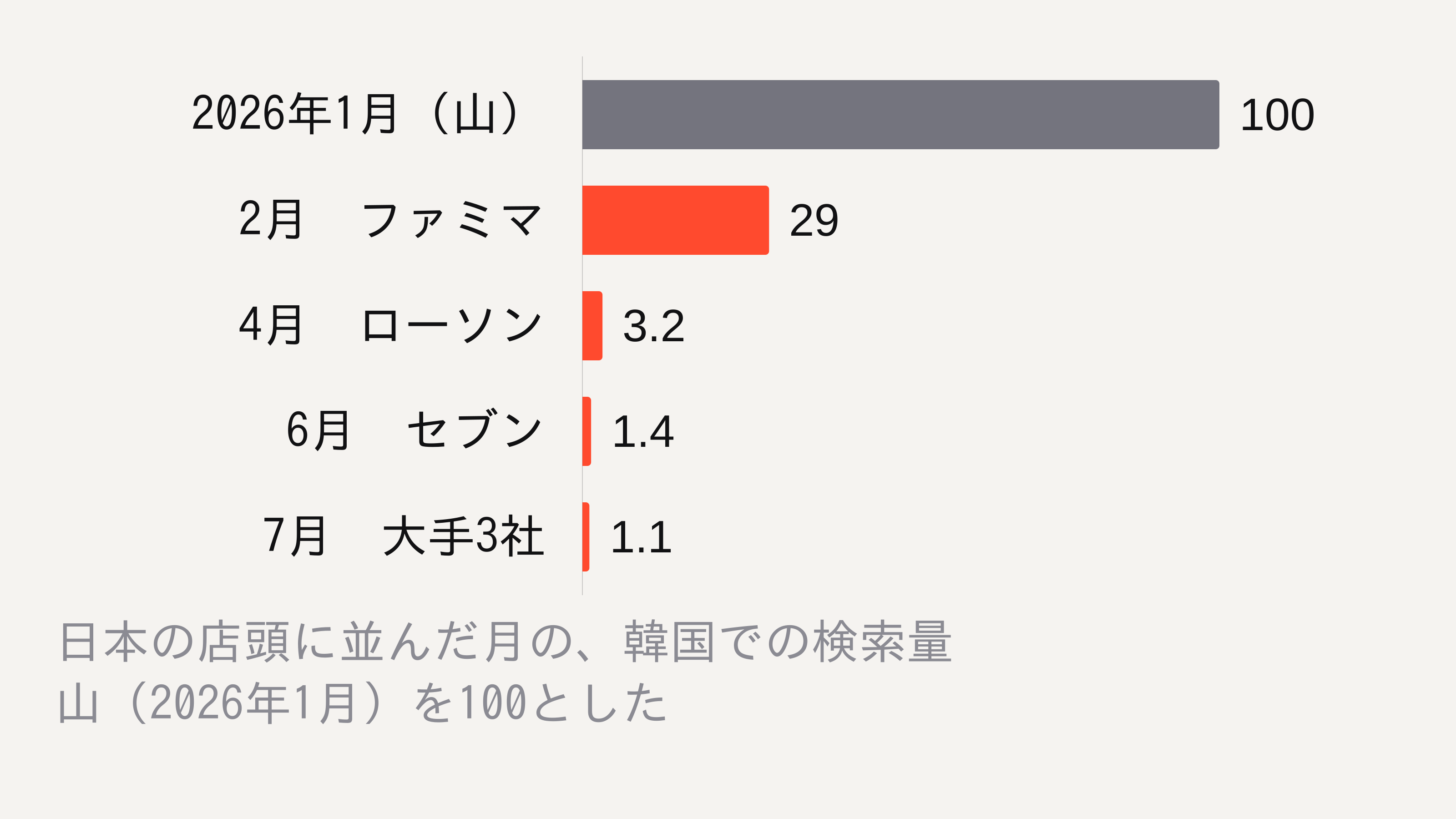
Japan was not late. The shelf was
Korean trends are supposed to reach Japan after a delay. Tested against the data, the gap in finding out was next to nothing; what lagged was the date the product reached the shelf. By the time it did, Korean search volume was at 1.4% of its peak.

A Korean convenience-store hit takes six months to build and four to erase
Two Korean dessert trends followed end to end, from first sign to gone. Both took six months from lift-off to peak, and four months from the peak back to where they started. Almost the same speed. The stage for both was the convenience store.
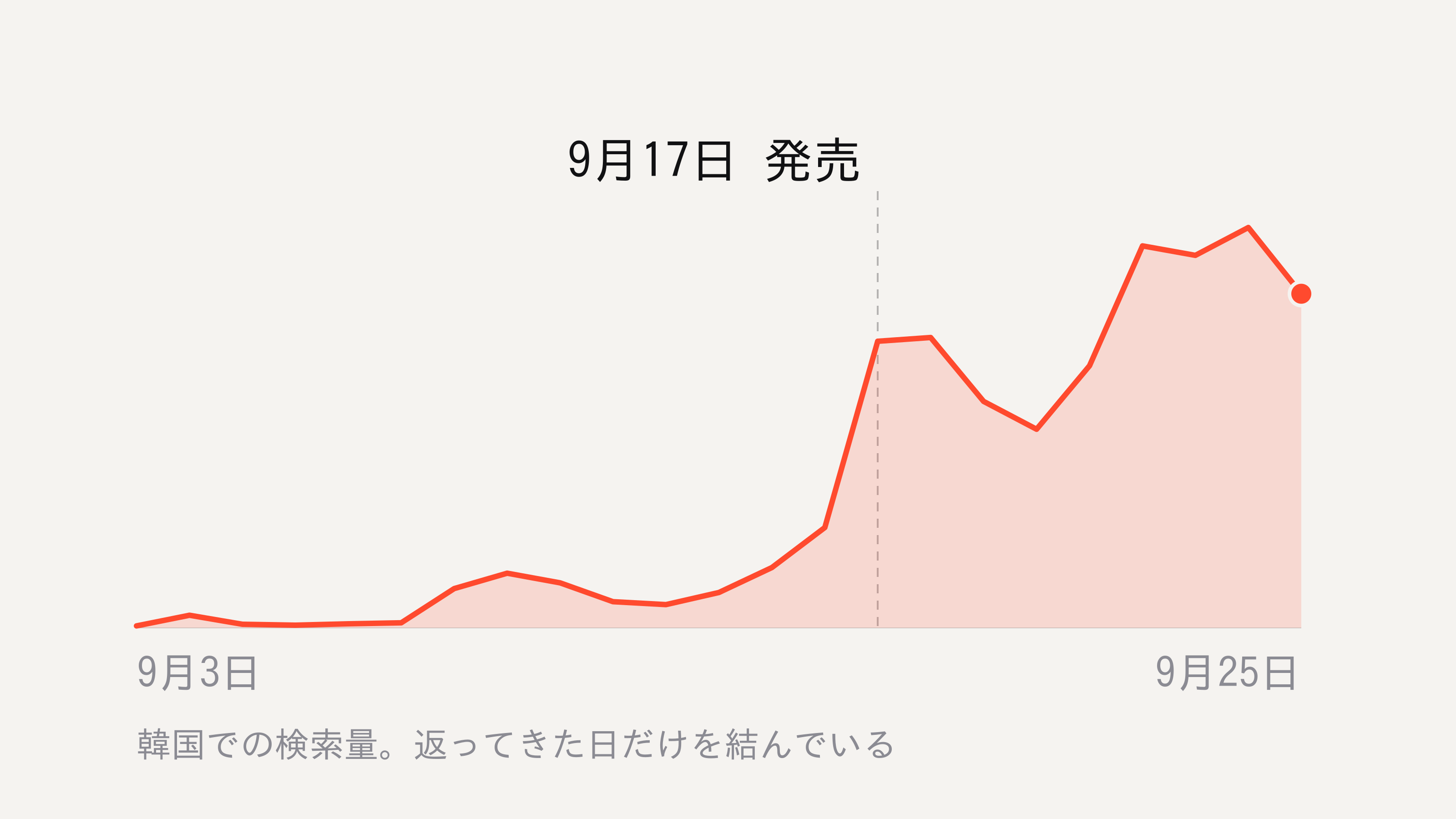
A bread you cannot buy in Korea. What is being sold is not the taste
Searches for the collaboration bread CU released on September 17 were still pointing up on the Korean side through September 25. On the two days when three of the four other words in the same request fell, this one rose 51.5%. The product name gets searched; the photocard gets written about.