“Daiso cosmetics” is not being searched any more. The chain is still growing
Coverage abroad started calling Korean Daiso's cosmetics remarkable. Two years of Korean search data put the high at February 2025, with today at a quarter of that. It does not mean people got bored.
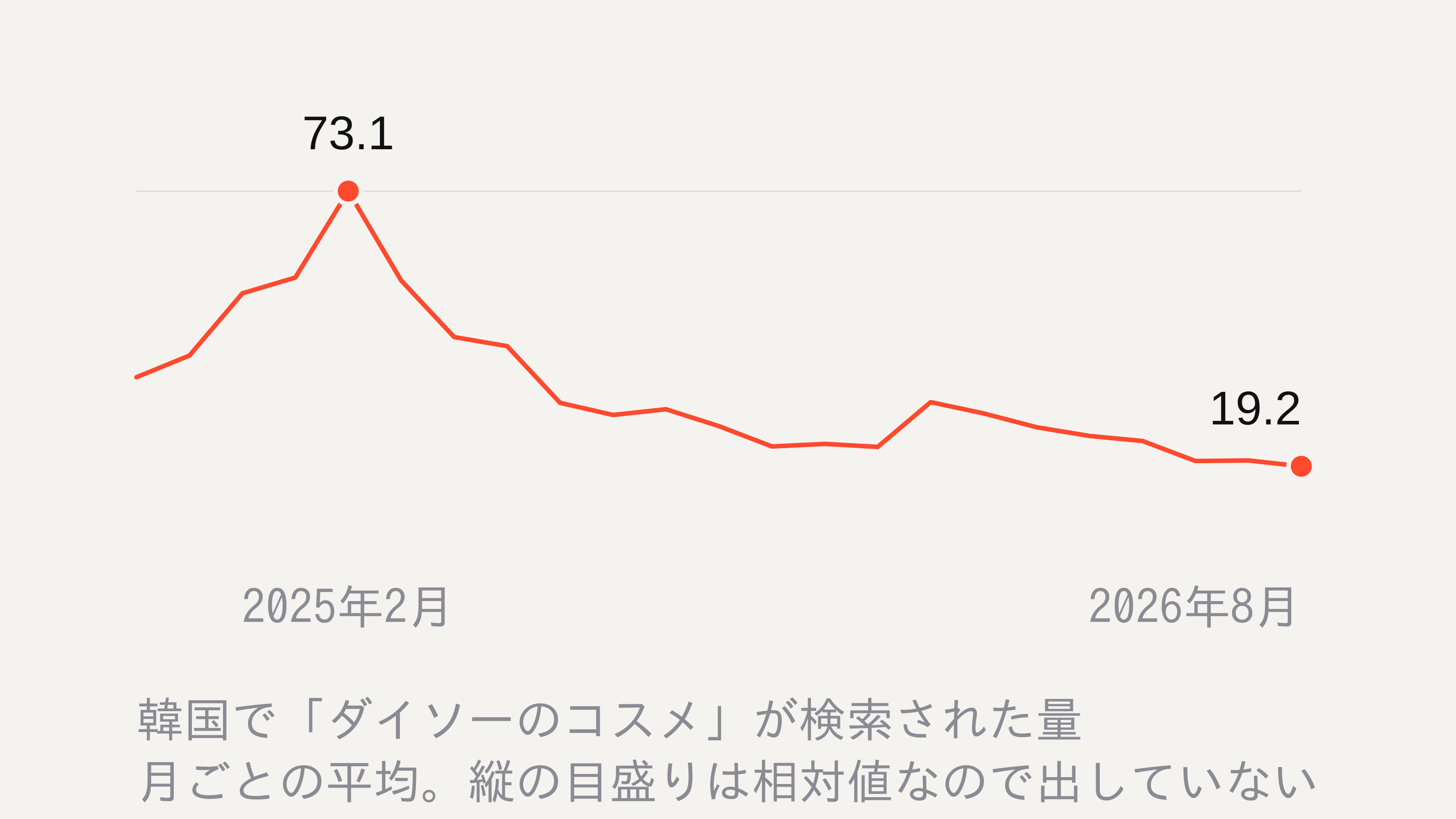
“In Korea, buying your cosmetics at Daiso is now the normal thing.” That line started appearing in Japanese-language coverage. Two years of Korean search data for 다이소 화장품 (Daiso cosmetics) were pulled to see whether it holds. It was not growing. The high is February 2025, and today is a quarter of it.
Reading that as “the boom is over” is a mistake, though. Over the same period, searches for the chain itself rose 22%, and revenue rose with them. Two things are being measured here and they are not the same thing: the name of the shop, and the name of a category inside the shop. They went opposite ways.
Korean Daiso is not Japanese Daiso
The sign and the logo are nearly identical, so the two get confused, but in ownership terms they are separate companies. In December 2023 the 34.21% stake held by Japan's Daiso Sangyo was bought out in full by 아성HMP (Aseong HMP), the Korean parent. The joint venture that had run since 1997 ended there. 다이소 in Korea now means a Korean company running Korean shops.
The pricing is worth knowing before the rest. Everything is sold at one of six prices: 500, 1,000, 1,500, 2,000, 3,000 or 5,000 won. Those six were settled in 2006, and the 5,000-won ceiling has not moved in twenty years. Roughly half of everything in the shop is a 1,000-won item.
When a variety store turned into a cosmetics counter
Cosmetics began to be added in earnest around 2022. As of January 2026 there are about 160 beauty brands in the shops and about 1,700 items. Against 2022, that is 23 times the brands and 14 times the items. Beauty revenue rose 144% year on year in 2024, which is 2.4 times.
What carried that growth was large manufacturers starting to build small Daiso-only lines. VT, Nature Republic, Holika Holika. A 5,000-won ceiling can be met by shrinking the volume and simplifying the box, so the ceiling worked as a design brief for dedicated products. The constraint did not get in the way; it built a new shelf.
Why this counts as hip rather than cheap
It sits differently from a plain one-coin store. Korean Daiso is not where you go to keep the cost down; it is where you go to try something first. Get it wrong and it cost 5,000 won. So more things get tried, and every trial produces a review.
The telling part is that people refer to items by product number rather than name. “Did you get 1019702?” passes as ordinary speech. With the brand pushed into the background, the number becomes the password. A way of buying that inverts the usual order — the dearer the better — works here as a game.
Where the numbers stand right now
First, how much the places to buy are searched. To take the season out, each month was matched against the same month a year earlier and averaged.
Daiso is the only one rising cleanly. Olive Young, the home ground of cosmetics, is down a tenth. Up to here, the story told abroad fits.
The percentages are changes inside each word's own series, so the relative scaling of the figures does not distort them. All five came from one request, which is also why the thin lines can be read against each other rather than only against themselves.
But “Daiso cosmetics” is half what it was two years ago
On the same scale, the words used inside the shop. 다이소 화장품, 다이소화장품 and 다이소 뷰티 were counted as one, so that a change in how people write it does not come out as a fall.
Eighteen months of steady decline. There is a small recovery in January 2026, but that shape turns up every January. It is not the high coming back.
Search fell while sales rose
This is where the point of the article sits. An estimate from consumption data for the same period is reported to put annual spending on Daiso beauty products up about 40% year on year. Search halved and the money spent went up. They are pointing opposite ways.
That 40% is a figure carried in Korean reporting, not one produced here. What this site holds is the search side, and the search side alone cannot say how much was sold.
Searching is what you do because you do not know. Buying is what you do because you do. A search high measures novelty, not the volume sold. So a high passing means the thing became ordinary, not that it was dropped. “Buying cosmetics at Daiso” stopped being worth looking up.
The habit of using product numbers supports this. Once you no longer need the category word, you go straight to the number next time. An entry word falling can be a sign that more people are already inside.
So what is being searched inside the shop
The ranking matters less than the way each word moves. Nails sat around 12 in the summer of 2024 and read 25.9 in August 2026. It rises in summer, so month against the same month it is 1.10 times — not dramatic, but the position has moved up. In July and August it passed cosmetics and came first inside the shop.
Perfume went the other way. It jumped to 20.1 between February and March 2025 and now reads 6.6, a third of what it was, in eighteen months. Its high came, and passed, before cosmetics as a whole started sliding. Inside one shop there are things arriving, things that arrived and passed, and things still to come.
None of those five words is a statement about how much was sold. They are what people typed next to the name of the shop, and that is all they are.
Coverage abroad is about a year and a half back
The month 다이소 화장품 was searched most in Korea was February 2025. Japanese-language coverage began saying “Korean Daiso is remarkable” after that — roughly a year and a half behind.
That is not a criticism. The order in which things travel is simply that. But knowing the order changes how you read. What gets introduced elsewhere as “popular in Korea” is usually not a trend locally but a fixture. What is worth following is the shelf rising quietly next to it. Three things to check:
- Whether the word is being searched locally (if not, either it has not become a word yet, or it no longer needs looking up)
- When the high came (more than a year ago means reading it as settled rather than as a trend)
- Whether search and sales point opposite ways (when they do, something has usually just become ordinary)
Collecting the data every day is for catching exactly that gap. As the Daiso case shows, “growing” and “being searched” can move separately. Watch only one of them and the read goes wrong.
From the desk. Search cooling off also means the place has become easier to shop in. Missing the moment everyone talked about it does not remove the shelf.
- The beauty section runs to about 160 brands and about 1,700 items, all at 5,000 won or less, so no time goes into comparing prices
- VT, Nature Republic and Holika Holika, among others, make small lines for this chain alone. The contents and the volume differ from the same brand's standard products, and they are sold only in Korean shops
- Look at what has settled on the shelf rather than what is being talked about. Anything that became a staple is being restocked, so it is less likely to be empty on the day you go
Chase what is current and you arrive at an empty shelf. What stayed behind after the trend passed is the better bet.
Sources
Read next
Related
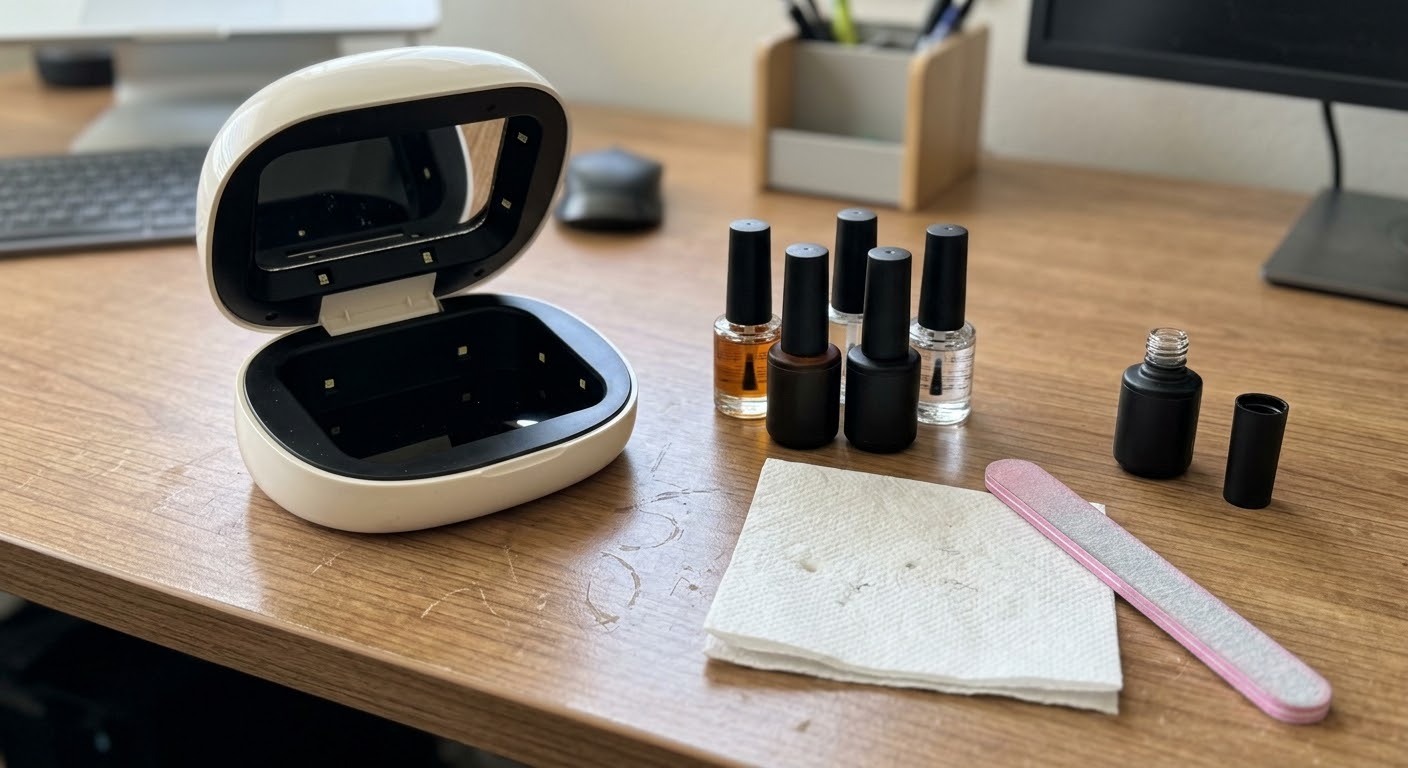
Korea is painting its own nails
Nails went past cosmetics on the Daiso shelf this summer for the first time. A 2,000-won bottle of gel and a 5,000-won ceiling put the home kit within reach. Searches for salons, though, did not fall. It looks like recession spending, and it is not only that.
Nothing came after glass skin. What disappeared was the worry
Matte is next, velvet is coming — the line has been repeated for years. Measured over two years, velvet returned a figure on 4 days out of 730. What actually halved was pores, tone-up and skin texture: the words for fixing skin.
Two years in which Olive Young fell and Daiso rose
Where Koreans buy cosmetics is changing places. Five retailers were followed for two years on one measuring stick: the only one that rose was Daiso, and the only one that clearly fell was Olive Young. It is not the ranking that moved. It is the direction.
Japan was not late. The shelf was
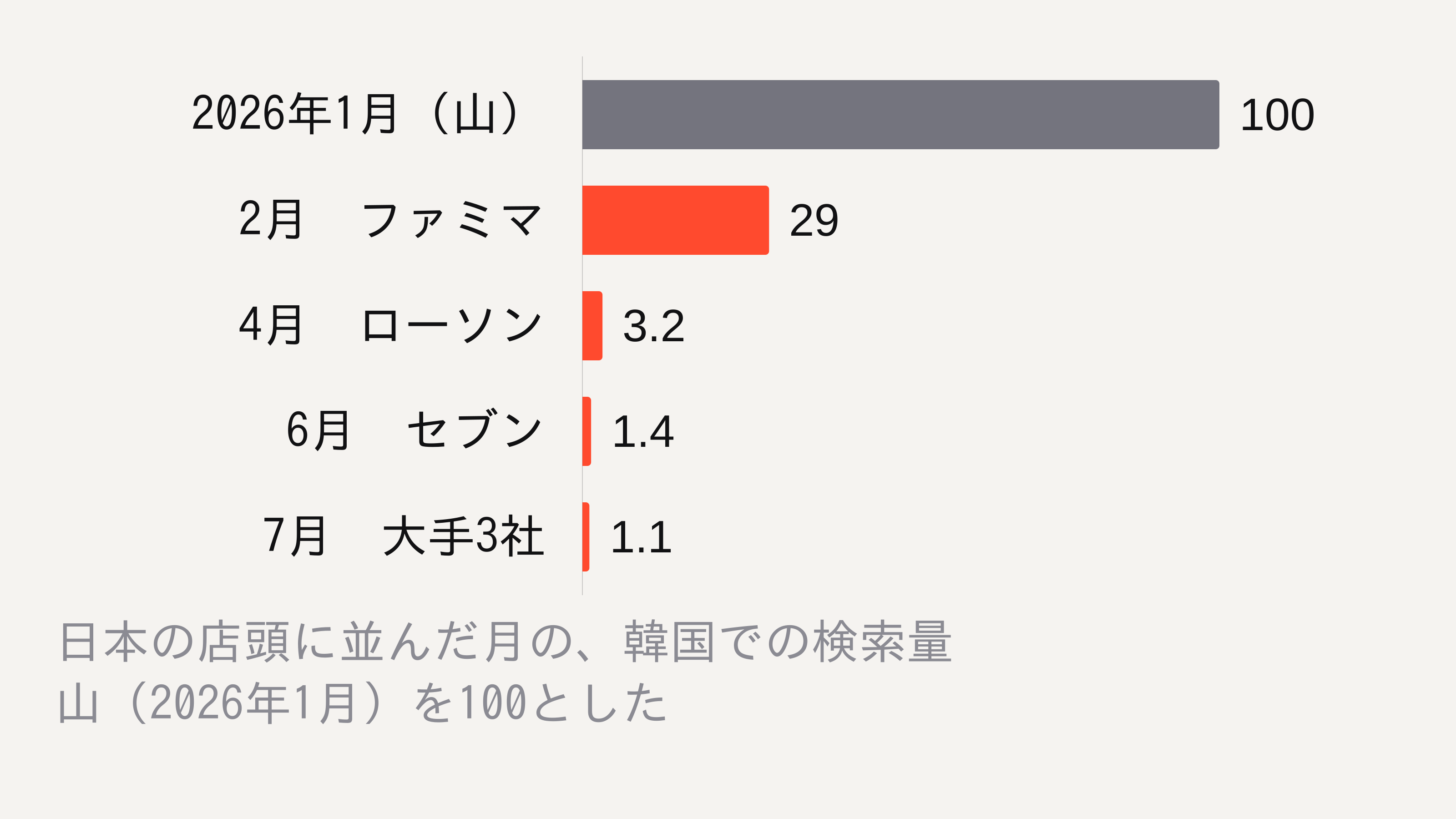
Korean trends are supposed to reach Japan after a delay. Tested against the data, the gap in finding out was next to nothing; what lagged was the date the product reached the shelf. By the time it did, Korean search volume was at 1.4% of its peak.
The chocolate you crack open has already passed its peak in Korea
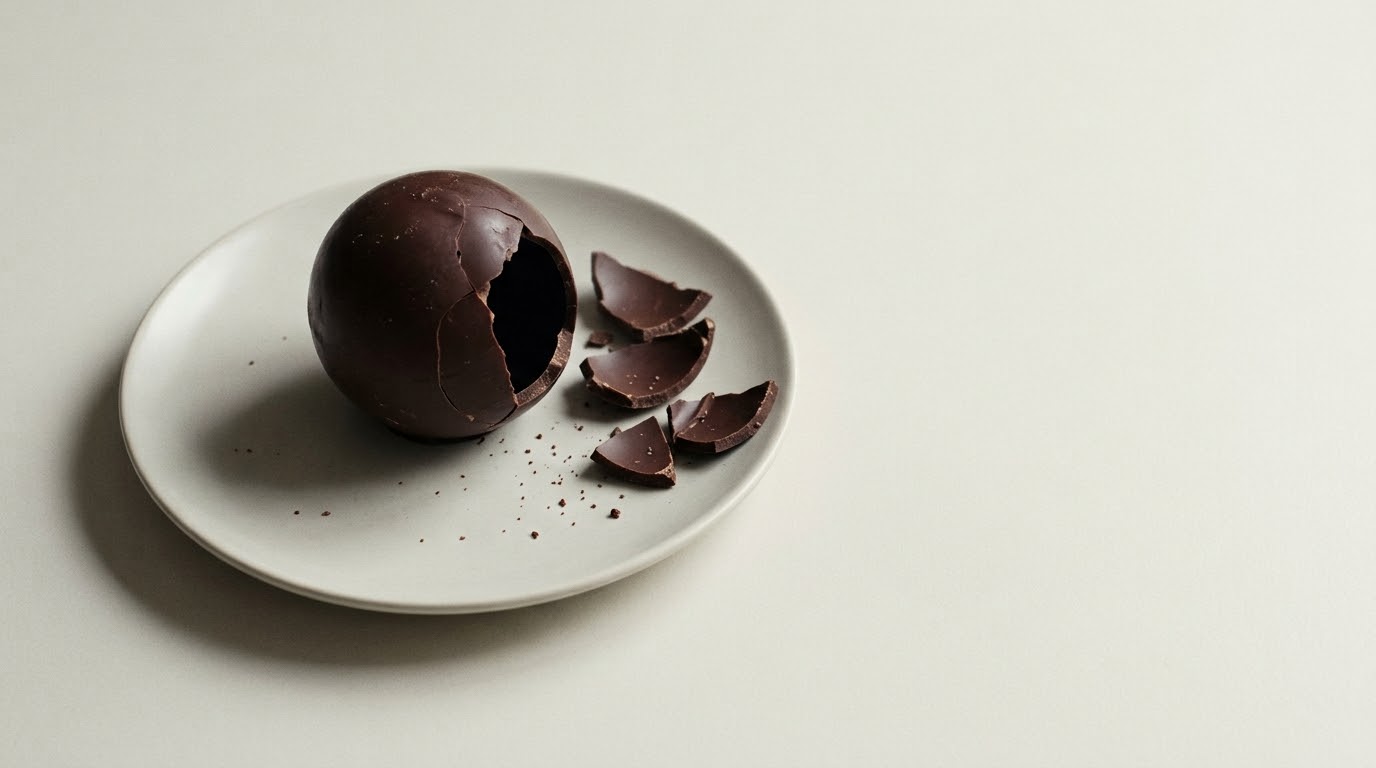
A thick chocolate shell you break apart with your hands. In Korea it is called 왁뿌 (wakppu). Checked against Korean search volume, the peak was three months ago. By the time the trend is written up abroad, the country has moved on.
A Korean convenience-store hit takes six months to build and four to erase
Two Korean dessert trends followed end to end, from first sign to gone. Both took six months from lift-off to peak, and four months from the peak back to where they started. Almost the same speed. The stage for both was the convenience store.